What Was the Focus of the Abstract Art Movement
Abstract Expressionism
Activity, Colour Fields and Emotion
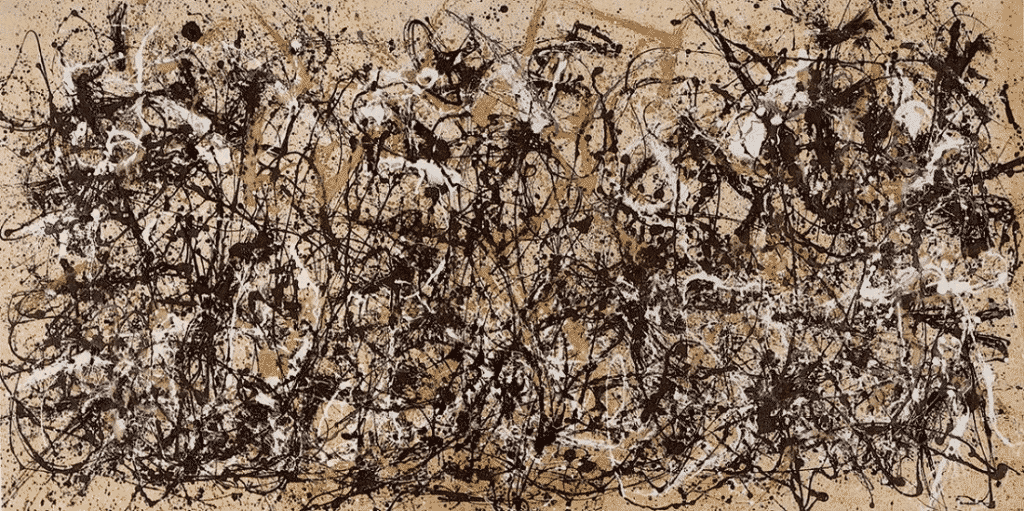
"Nosotros felt the moral crisis of a globe in butchery, a earth destroyed past a bang-up depression and a vehement World War, and it was incommunicable at that time to paint the kind of paintings that we were doing—flowers, reclining nudes, and people playing the cello."
Barnett Newman
After a earth state of war that is so vicious, and then savage, how tin we merely continue with life, and art, in the same mode as before? This is the question many artists were request themselves after the 2nd Earth War. In 1940s and 1950s New York, a new fine art movement started emerging in which artists began exploring expression of emotions and feeling through abstract, gestural mark-making and imposing color fields. These artists felt they could no longer proceed to paint figures after the horrors of the war. They instead sought refuge in the abstruse realm, encouraging meditation and introspection. These artists came to be known equally the Abstract Expressionists.
- Key dates: 1940s and 1950s
- Key regions: New York
- Primal words: action painting, colour field painting, New York School, spirituality, emotional expression, spontaneity, gestural marker-making, sublime
- Key artists: Jackson Pollock, Lee Krasner, Mark Rothko, Willem de Kooning, Elaine de Kooning, Barnett Newman, Clyfford Still, Franz Kline, Harold Shapinsky, Robert Motherwell, Helen Frankenthaler, Cy Twombly, Ann Ryan, Advert Reinhardt
The Emergence of Abstract Expressionism
In the years following Globe War II, a group of artists who rejected figuration in favour of abstraction emerged in the United states. They became known equally the Abstract Expressionists.
The rise of fascism in 1930s Europe and the resulting war had brought a wave of immigrant artists over to the United States. These artists brought with them ideas and practices of European Modernism. Many artists trained at the Hans Hofmann School of Fine Arts, founded by the German painter Hans Hofmann, or at the experimental Blackness Mountain College in North Carolina, where Joseph Albers taught. The European influence taught artists well-nigh the formal innovations of Cubism, and the automatism and psychological underpinnings of Surrealism.
The Abstract Expressionists were deeply influenced past the thought of exploring the unconscious which reigned in Surrealism, and by the ideas of Swiss psychologist Carl Jung and his exploration of myths and archetypes. They also gravitated towards existentialist philosophers similar Jean-Paul Sartre. The Abstruse Expressionists expressed emotions and universal themes through their often monumental canvases in a style which fit with the post-state of war mood of trauma and anxiety.
The Different Styles
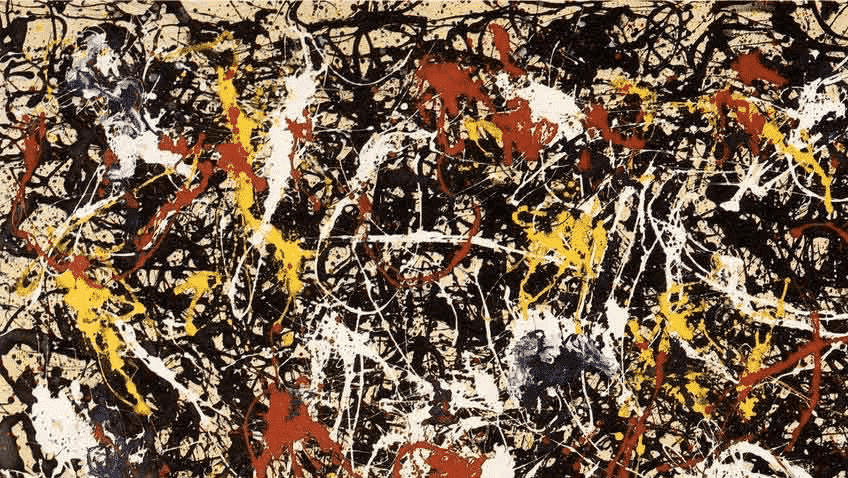
Within Abstruse Expressionism, we tin can differentiate betwixt two tendencies: the action painters and the colour field painters.
Action Painting
The action painters were Abstruse Expressionist artists whose approach to painting focused on the concrete act of painting. Their working process involved splashing and dripping paint on the canvass, and they frequently used wild, course, gestural brushstrokes instead of carefully applying paint. The art critic Harold Rosenberg coined the term action painting in his article "The American Action Painters," which was published in ARTnews in December 1952. Arshile Gorky, Franz Kline, Willem de Kooning and Jackson Pollock were all considered action painters. Pollock, with his large drip paintings, is arguably the well-nigh well known activeness painter.
Colour Field Painting
The term colour field painting was get-go used in 1955 past Cloudless Greenberg to refer to the work of Marking Rothko, Barnett Newman and Clyfford Still. These artists were painting simple compositions with large areas of usually a single flat colour which were meant to produce a contemplative or meditative response. The colour field artists were searching for transcendence, and their expansive, emotive fields of colour were meant to engulf the viewer and inspire spiritual contemplation and intense feeling.
Iconic Artworks of Abstract Expressionism
Jackson Pollock'sNumber 1A (1948)
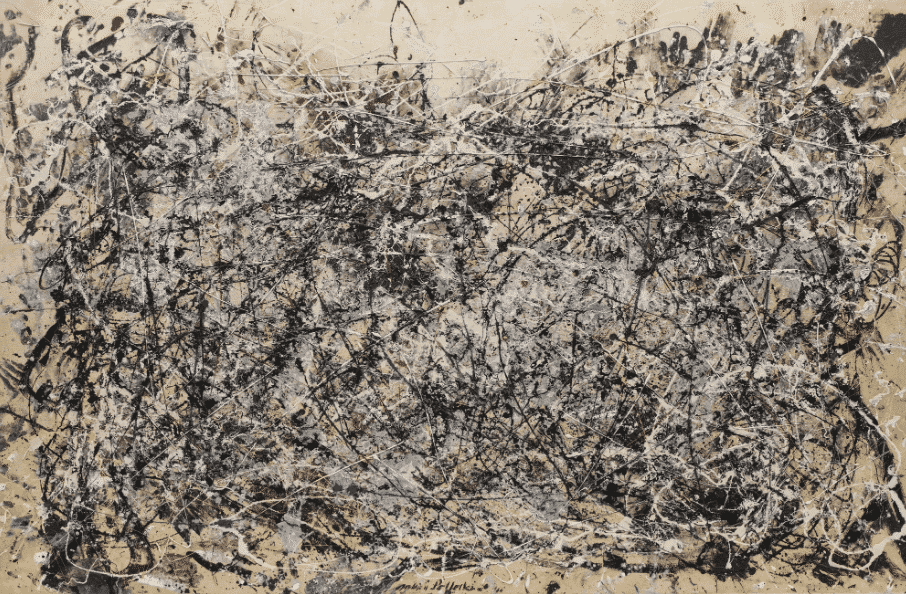
In 1947, Jackson Pollock discovered a new style of painting. The method consisted of flinging and dripping paint onto an unstretched sheet, laid on the floor of his studio. The style became known equally drip painting. Baste painting immune Pollock to work with improvisation, spontaneity, movement and feeling. In his drip paintingNumber 1A, Pollock has added his handprints to the composition's upper right as an autograph. He moved away from traditional artist'south oil paints and used commercial enamel paints for his baste paintings. Due to the fluidity of this paint, he was able to directly capture the movements of his body over the canvas. Pollock chose to no longer give his paintings evocative titles and began to number them instead, because numbers are neutral and would allow people to experience the pure painting.
Marking Rothko'sSeagram Murals (1958-1960)
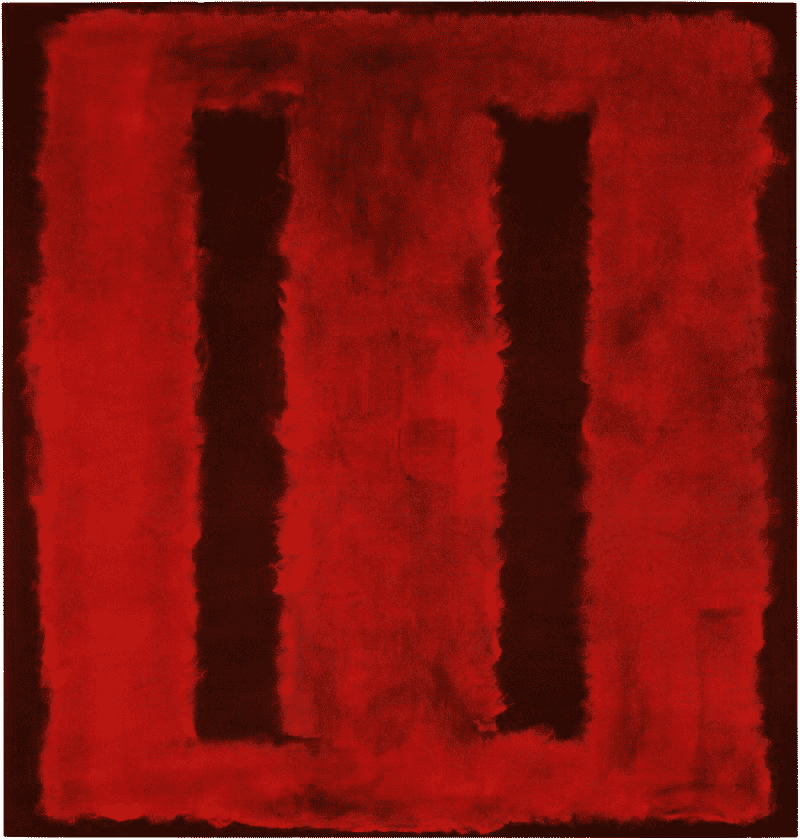
In 1958, Mark Rothko was commissioned to create a series of murals for the dining room at the Iv Seasons Restaurant in New York's Seagram Building. He worked on the commission tirelessly for two years, creating a serial of deeply moving colour field paintings in dark reds, maroons and blacks that came to exist known every bit the Seagram Murals. Rothko stated that with his Seagram Murals, he had created a identify. He eventually withdrew from the commission and donated most of the paintings to the Tate Gallery in London. The Seagram Murals exemplify the desire of the colour field painters to achieve spiritual transcendence and to convey intense emotional experience.
Willem De Kooning'sExcavation(1950)
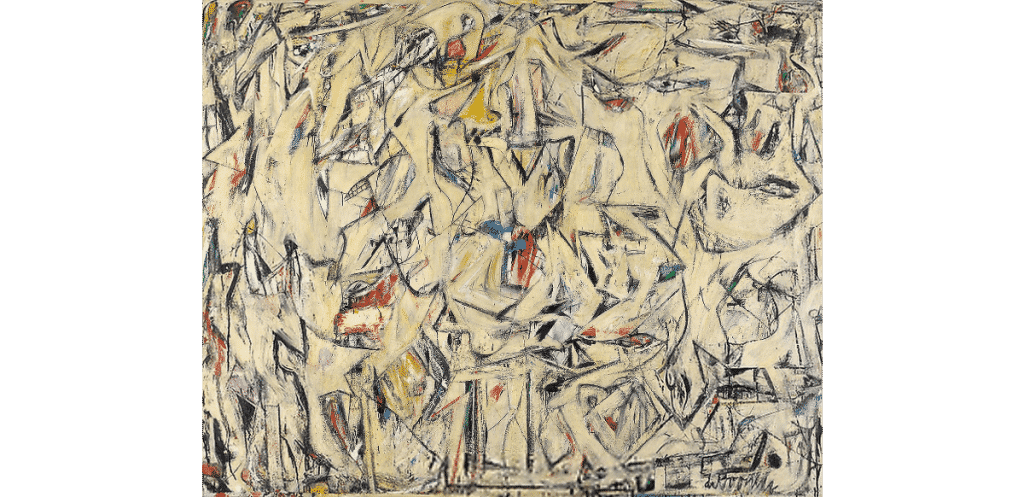
Willem de Kooning'southDigging was his largest painting up to that date, and exemplifies De Kooning's characteristic expressive brushwork and organisation of infinite into different sliding planes. The creative person took inspiration by an image of women working in a rice field in the 1949 Neorealist filmRiso Amaro past Giuseppe de Santis. The tension betwixt abstraction and figuration is axiomatic hither, in the calligraphic lines which seem to define anatomical parts. De Kooning's intensive painting process included building upwards the surface and scraping down its paint layers for months on end until he achieved the desired effect.
Barnett Newman'southwardOnement (I)(1948)
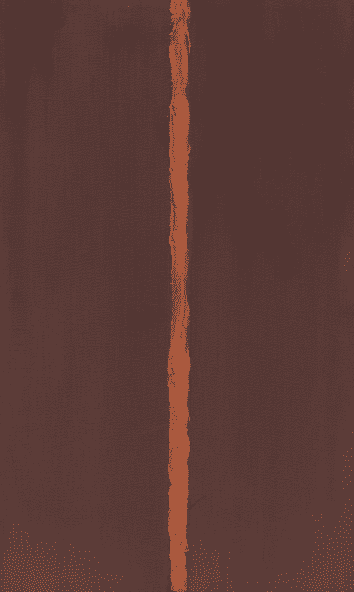
For Newman,Onement (I)was his artistic breakthrough. It was the first time for the artist to employ a vertical band to define the spatial structure of his piece of work. This vertical band, which Newman later on started calling a "zero," was to get Newman'due south signature mark. The thick, irregular band both divides and unites the limerick. Newman sought to paint from scratch, as though painting had never existed before. He saw his compositions as forms of thought and expressions of the experience of being alive.
"The modern artist is working with infinite and time, and expressing his feelings rather than illustrating."
Jackson Pollock
Abstract Expressionism Across New York
With Abstruse Expressionism, New York became the new centre of the art globe. Withal beyond New York, there were many fine art movements which were likewise moving away from representation in favour of abstraction. In Europe in the 1940s and 1950s, for example, there was Art Informel, which refers to different tendencies of abstract painting such equally tachisme, matter painting and lyrical abstraction. Though mainly referring to European art, artists were as well inspired past and embracing American Abstruse Expressionism. Like the Abstract Expressionists, these artists took inspiration from Surrealism and its focus on the subconscious and automatist painting.
The Influence of Abstract Expressionism
Abstract Expressionism flourished in the 1940s and 1950s, and the paintings were seen all over the earth in travelling exhibitions and publications. By the 1960s, Minimalism and Pop Fine art had started replacing Abstract Expressionism as the dominant art movement. The new generation of artists had tired of the serious, grand ambitions of the Abstruse Expressionists and their desire to portray transcendence and the sublime in fine art. Yet the legacy of Abstract Expressionism remains considerable.
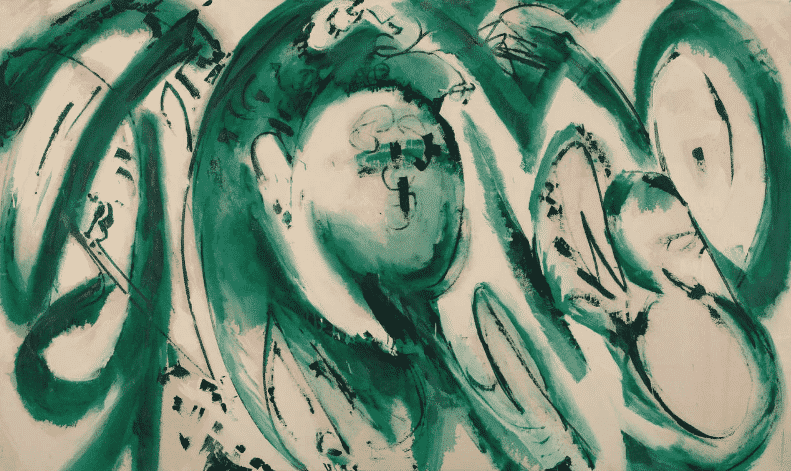
Take, for case, Frank Bowling, an artist who moved to New York in the mid-60s and was profoundly influenced by Abstract Expressionism there, continuing to pigment in this style throughout his career, regardless of what the popular styles of the times were. Moreover, in recent years, female Abstract Expressionists like Lee Krasner, long overshadowed by their male person contemporaries, are also receiving the attention they deserve. The Denver Art Museum's 2016 show "Women of Abstract Expressionism" historic the often unknown or underappreciated female person artists of this groundbreaking art movement.
Relevant related manufactures:
- Lost (and Found) Artist Serial: Lee Krasner
- Lost (and Found) Artist Series: Frank Bowling
- Top 25 Art Movements and Styles: Throughout History
- Stories of Iconic Artworks: Marking Rothko'south Seagram Murals
Source: https://magazine.artland.com/abstract-expressionism/
0 Response to "What Was the Focus of the Abstract Art Movement"
Post a Comment